Paris
Interview with the VampireParis is not merely a destination in Louis’s journey but a temporary answer to his despair. After the failed search for meaningful vampires in Eastern Europe, the city gives him an intoxicating sense of renewal, cultural belonging, and freedom. Yet its beauty contains the same structures of concealment, spectacle, imprisonment, and death that govern his supernatural existence. In Paris, Louis finds a home, a vampire community, and a language for his longing; he also loses Claudia and Madeleine, destroys the theater that sanctioned their deaths, and eventually leaves with Armand, carrying the city as both refuge and wound.
Arrival and the City’s Meaning
Paris enters the narrative as a decision made under exhaustion and estrangement. In a hotel room near the first capital of Western Europe, Claudia concludes that she and Louis have approached their search incorrectly. Rather than continuing through Vienna, she insists that they need their own language and their own people, and that they must go directly to Paris. The change of destination is therefore more than geographical. It marks a movement away from the mindless, folkloric vampires encountered in Transylvania, Hungary, and Bulgaria toward a modern urban culture in which vampires might possess history, organization, and self-knowledge.
Louis responds to the name of Paris with a rush of pleasure so strong that it approaches well-being. The city recalls Europe as the source of his language, reading, historical imagination, and Creole identity. He had long wanted to see the place from which the culture that shaped him had emerged, and Paris seems to satisfy that desire immediately. Compared with New Orleans, which he sees as beautiful but fragile, continually threatened by hurricanes, floods, fever, plague, damp, and the wilderness surrounding it, Paris appears whole and self-contained. Under the Age of Napoleon III, its buildings, cathedrals, boulevards, medieval streets, galleries, theaters, cafes, and Seine form a historical universe that seems almost as durable as nature itself.
The city’s grandeur briefly permits Louis to forget that he is a damned and questing creature. Paris overwhelms him with mortal beauty and human achievement, but it also absorbs those things into a larger urban totality. He experiences the city as a place where art, philosophy, sanctity, war, frivolity, and genius continually regenerate one another. This apparent permanence is crucial to Paris’s attraction: it offers a vision of civilization that seems capable of containing death without being defined by it.
The Hôtel Saint-Gabriel and Vampire Society
Claudia moves Louis into the Hôtel Saint-Gabriel on the Boulevard des Capucines, where they take one of the finest suites in a hotel rumored to be among the largest in Europe. Their windows look over gas-lit streets crowded with strollers and carriages carrying elegantly dressed passengers toward the Opéra, the Opéra Comique, the ballet, theaters, balls, and receptions at the Tuileries. The hotel gives them privacy and anonymity within the constant movement of European tourism. Its staff maintains their rooms without asking questions, while the high price secures both their safety and their nocturnal habits.
Claudia’s lavish furnishing of the suite reveals that Paris is also an attempt to reclaim a world. She orders rose-and-gold wallpaper, damask and velvet furniture, embroidered pillows, silk furnishings, roses for the marble mantels and inlaid tables, and a garden of camellias and ferns before the tall French windows. Her repeated search for flowers expresses homesickness as much as taste: she says that she misses them more than anything else. The rooms thus become a manufactured habitat, joining the splendor of Paris to the domestic world she and Louis once created in New Orleans.
Paris also offers Louis access to a structured vampire culture. At the theater, he encounters Armand, the auburn-haired vampire whose stillness and remote expression distinguish him from the theatrical crowd around him. Armand leads Louis and Claudia beneath the theater into a vast subterranean ballroom decorated with enormous murals, including Breughel’s Triumph of Death and The Fall of the Angels. The descent transforms the city’s cultural sophistication into an underworld of death, damnation, and spectacle. Paris’s public theater and its hidden vampire chambers are not separate worlds: the underground community turns the imagery of death into the visual language of its social order.
Churches, Art, and the Search for Meaning
Paris intensifies Louis’s conflict between mortal culture and vampire existence. His religious longing reappears in the cathedral he enters after years of avoiding it. The church recalls the funeral rites of Paul, including incense, rosaries, women’s voices, candles, and the procession carrying his coffin. In the cathedral, Louis confronts a priest and demands an explanation for the existence of a creature like himself. He displays his teeth, asks why God permits him to live, and finally attacks the priest at the Communion rail. Paris therefore brings him into direct contact with the religious institutions that once gave death a ritual meaning, but the encounter produces neither absolution nor knowledge.
The city’s art offers a different kind of sanctuary. After Claudia and Madeleine are destroyed and the Théâtre des Vampires has burned, Louis wanders toward the Louvre because he believes its paintings may offer solace without requiring him to bring death to anything. He had long imagined entering the museum and moving through its rooms as a mortal man. In the aftermath of catastrophe, however, art no longer promises access to the human heart. The paintings become objects detached from their makers, beautiful but lifeless, comparable to preserved children, dolls, and the remains of Claudia and Madeleine. The Louvre can receive his grief, but it cannot restore the human meaning that grief has lost.
This change alters Louis’s relation to Paris itself. At first, the city seems to promise happiness, cultural belonging, and an escape from supernatural isolation. After the theater’s destruction, its beauty becomes inseparable from severance. The city’s objects, people, and artworks appear capable of being cut loose from their origins and reduced to ash, just as the vampires and their possessions can be destroyed. Paris remains magnificent, but its magnificence no longer guarantees intimacy or redemption.
Violence, Imprisonment, and Departure
Paris is the setting for both the height of Louis’s connection with vampire society and its most devastating betrayal. The theater presents vampiric violence as performance, placing human spectators before staged scenes whose apparent fiction conceals actual killing. Louis recognizes the danger only gradually. When he watches a girl die in the theater, the taste of her blood remains with him after the applause begins and the audience leaves. Claudia urges him to have patience, and at that moment Armand appears, leading them into the theater’s hidden rooms.
The city’s underground architecture becomes a literal system of control after the vampire community condemns Claudia and Madeleine. Louis is sealed inside a coffin while hearing Madeleine’s cries and fearing that Claudia’s cries will follow. The coffin is carried away, placed in the earth, and enclosed by newly laid bricks. Trapped in darkness, Louis imagines that Armand will return to release them, while the physical confinement turns his fear into panic and then paralysis. Paris’s hotel rooms, theater cells, coffins, and burial spaces form a connected geography in which shelter can become imprisonment without warning.
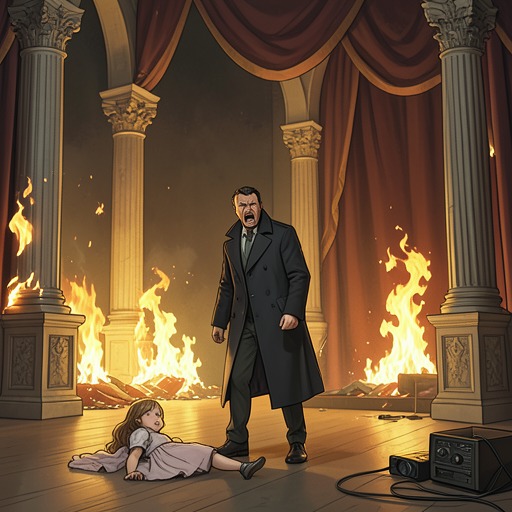
Louis survives and responds through calculated destruction. Before dawn, he uses a carriage, a small scythe, and two barrels of kerosene to enter the closed Théâtre des Vampires. He nails boards across its bolted doors, then splashes kerosene through Armand’s cell, the other underground chambers, the ballroom, the chairs, draperies, corridors, and theater itself. He hesitates at the door behind which Claudia and Madeleine were killed, but continues because their remains are no longer there and the act has become one of retaliation rather than recovery. The theater burns as Louis converts its own stagecraft into a real conflagration.
Armand’s role complicates the revenge. He has removed his coffin before the fire and later tells Louis that the human guards were absent because Armand had employed and dismissed them. He neither warns the theater’s vampires nor seeks vengeance against Louis. This knowledge makes the destruction less a simple conflict between rival factions than a rupture within a concealed community: Armand’s silence permits Louis’s act, even as his explanations leave the moral meaning of that permission uncertain.
Memory, Loss, and the Parisian Afterlife
After the fire, Louis is more alone than at any earlier point in his existence. Claudia is gone beyond reprieve, and Madeleine is dead, yet his sorrow does not arrive as the dramatic collapse he expects. He is numb, unable to sustain the torment produced by seeing Claudia’s burned remains. Armand walks beside him toward the Louvre, and Louis learns that Armand does not despise him, does not intend revenge, and has deliberately withdrawn the theater’s guards. Their exchange creates a fragile bond founded not on innocence but on mutual knowledge of guilt, loss, and supernatural isolation.
Louis returns briefly to the Hôtel Saint-Gabriel before leaving Paris. He intends to gather belongings belonging to Claudia and Madeleine and arrange graves for them in Montmartre Cemetery, but the orderly rooms make the task seem meaningless. Madeleine’s embroidery ring remains beside her bundles of thread, and the untouched suite suggests that the dead might still return. He leaves without completing the burial preparations, carrying instead the unresolved material traces of the women who had defined his life in Paris.
Louis and Armand soon depart Paris without ceremony. Louis wants to return to the Mediterranean and continue to Egypt, where he hopes to see the pyramids, the graves of kings, and the art and furnishings preserved in unopened tombs. Paris has given him access to art and history, but it has not answered the questions that brought him across the Atlantic. Later, while living for a long time in New York, Louis learns from Armand that Lestat survived the theater fire and was helped toward New Orleans by two vampires made by the same master. This revelation reopens the emotional connection Louis had tried to suppress and causes him to return to New Orleans.
Paris therefore remains a decisive place even after Louis leaves it. It is the city where freedom first seems imaginable, where Claudia’s search for her own kind reaches its most dangerous fulfillment, where Louis encounters Armand, and where love, art, religious fear, theatrical illusion, and revenge become inseparable. Its streets and institutions offer civilization as splendor, but its hidden rooms reveal the violence required to preserve that splendor. Paris does not cure Louis of his despair; it gives that despair a grander architecture and sends him onward carrying beauty, guilt, and memory together.